

Notable moments of Black history at Towson University
By Kendra Bryant, Deputy Arts and Life Editor
This February marks 100 years of Black History Month in the United States. In 2025, 33% of Towson University’s student body were African American. Over the years, Towson has continued to mark new historical milestones within Black History. Here are some of its notable milestones.
1959
Towson University hosted its first African American graduates, Myra Harris and Marvis Barnes, in 1959. The two were admitted to the college shortly after the infamous U.S. Supreme Court case, Brown v. Board of Education. Upon speaking with former director of admissions, Rebecca Tansil, Harris transferred to Towson State as an elementary education major. Harris later earned a master’s degree from Columbia University and went on to serve as principal of two Baltimore City Public Schools. Barnes received her master’s from Loyola University Maryland and worked as a social studies teacher before becoming a department chair at Northwestern Senior High School. In 2022, Towson University re-named two residence halls after the women and West Village is now home to Harris and Barnes Hall.
1961
In the 1961, Nov. 17 edition of Towson University’s newspaper, The Towerlight, student Bettina Monroe penned a letter to the editor titled “Agitation Necessary Before Integration.” Monroe wrote that the power of protest was the only way to implement governmental change. At the time of this publication, the Civil Rights Movement was taking place, and freedom rides and sit-ins were widely broadcast. Her use of the word agitate reflects what is known today as activism. Monroe later attended graduate school at Morgan State College.
“We want students to feel comfortable being their whole selves, knowing that their identities, cultures and histories are respected,” Patricia Bradley, vice president of Towson University’s Office of Inclusion & Institutional Equity, said in an email.
1970
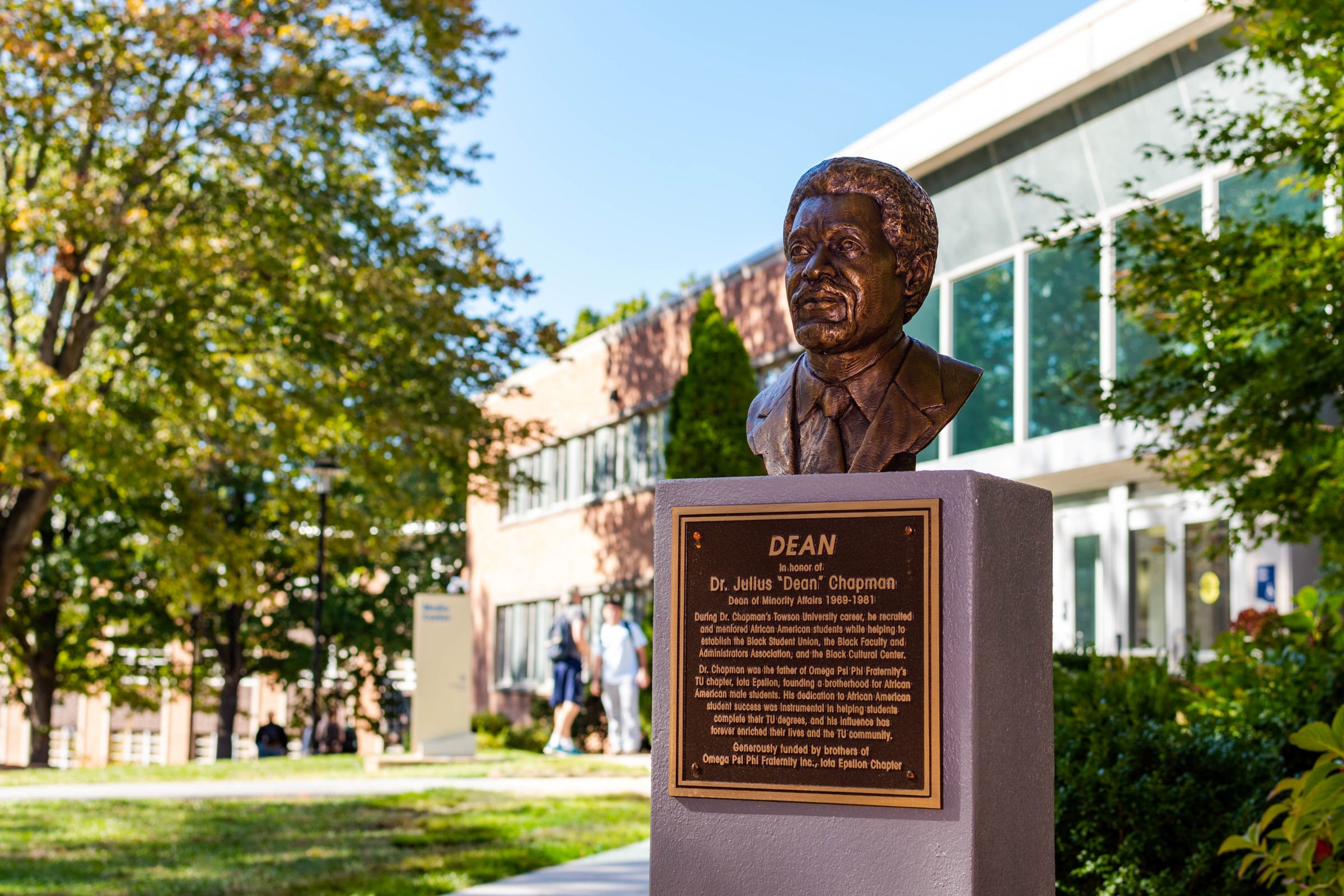
Towson University’s Black Student Union was formed through a movement of action in February of 1970. The groups first President Arthur Woodard and a group of Black students demanded a space dedicated to the university’s Black population, which would require university funding, office space and staff support. BSU efforts were supported by Julius Chapman, Towson University’s dean of Minority Affairs. When he first arrived, enrollment of Black students made up less than one percent of Towson’s student population. Now, they make up a third. The Chapman Quad next to Cook Library is named after him.
“Creating safe spaces for Black students at TU means committing to an environment where students are seen, valued, protected, and empowered—not only socially through programming, but also academically and institutionally,” Bradley said.
1973
In 1973 the first Black Greek organization at Towson was established, the Rho Chapter of Iota Phi Theta Fraternity, Inc. Then-students Jerome Murphy, Robert Robinson, Craig Gray, Chuck Myer and Francis Clay helped found the chapter. The fraternity was initially founded in 1963 at Morgan State College. Its legacy of scholarship, citizenship and brotherhood continues through philanthropic efforts. A monument to all nine of Towson’s historically Black Greek organizations is displayed near Chapman Quad.
2022
Jordan Colquitt became Towson University’s first African American Student Government Association president to serve two terms. He led the 2022-23 and 2023-24 terms for the 102nd and 103rd administrations. As president, he created executive positions dedicated to first-generation and income-limited students, established the “First Generation Futures” scholarship and led the resolution to create excused absences for mental health days. Colquitt was also a member of Towson University’s Army ROTC program, Brotherhood, the Pre-Law Society and Students Helping Honduras. He is now a JD candidate at Rutgers Law, serving as a 1L representative for the Student Bar Association and the Association of Black Law Students.
“I was especially proud to see the student wellness day implemented,” Colquitt said. “It took a lot of heavy lifting from not just our executive board but other members of the administration.”