

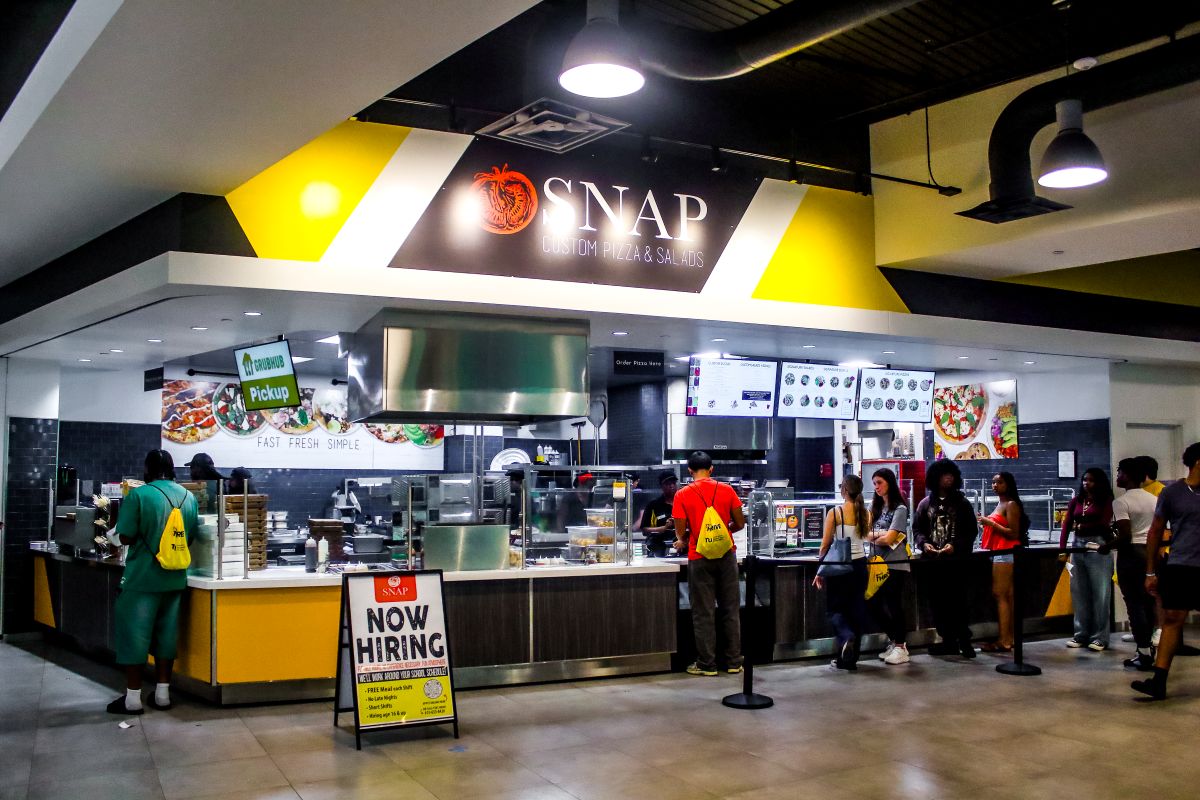
Students were charged $1.50 for the box their pizza came in. It didn’t last long.
By Cameron Wilson, Contributing Writer
At the beginning of the spring semester Towson University students found they were being charged $1.50 for certain compostable take out containers for their food at university dining locations. The surprise cost has since been removed after student complaints.
Signs posted at multiple campus dining locations said customers could either pay an additional fee of $1.50 for a compostable takeout container, or use the university’s ReusePass system for free, which allows students to borrow reusable containers and return them at designated drop-off points.
The signs appeared at SNAP Pizza, Halal Shack and Burgers + Fries in Newell Hall. The messaging framed the change as an environmental initiative intended to reduce single-use waste. The cost also applied to any Grubhub orders.
The compostable containers that the locations were charging for were the same cardboard pizza boxes and bowls used in previous semesters.
“I just think it’s kind of stupid. I already paid tuition to go here. I don’t even know what [the] majority of my tuition money goes to. It’s unnecessary, it’s just causing more stress for the students and stuff like that as well,” first year Anne-Kady Tedegranpin said.
Towson’s dining is run by Aramark Collegiate Hospitality. When asked about the decision to implement the container charge, by the time Aramark responded, the $1.50 cost was gone. The Towerlight confirmed the charge was completely gone by Feb. 9.
“Tiger Hospitality is not currently charging a fee for take-out packaging at any of our retail locations. The reusable to-go containers through Reusepass are still available at all locations to encourage a greener campus,” Marketing Manager Bethany Comegys said in an email.
Comegys did not respond to questions about why the charge was implemented in the first place.
The lack of clarity on the additional fee left students feeling confused and wondering what other charges are going unnoticed. Some students said they only learned about the $1.50 charge for their food’s container after noticing a slight increase in the total on their receipt.
“My friend and I were planning to test whether each of the containers had the same amount of food, but the charge was taken away before we could. I didn’t want the fee, but they could’ve communicated the change better,” sophomore Maeve Morrsion said.